Antek’s killing of the woodsman
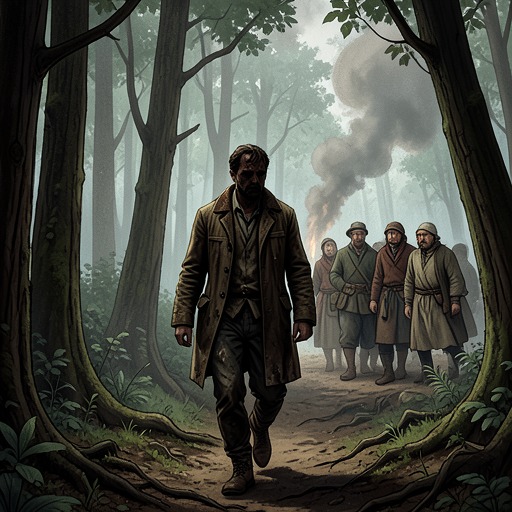
The PeasantsAntek’s killing of the woodsman becomes consequential in the story through what follows: the threat of prosecution, the possibility of a long sentence, and Antek’s apparent flight before the case can be proved. The killing itself is not shown in these passages. Instead, it is reconstructed through other people’s talk and through Antek’s halting effort to explain why he has come to The Parish Priest of Lipce, leaving the event’s practical and emotional consequences in view while its circumstances remain unstated.
The killing as a reported event
The account identifies Antek with a man who has gone to America and is said to have killed a guard. When someone raises the question of whether the authorities proved the killing, the reply is that Antek did not wait for them to do so. The exchange presents flight as a response to the danger of prosecution, but it does not describe the killing, identify its immediate circumstances, or establish a verdict. The distinction matters: the event is treated as a grave accusation with life-changing consequences, not as a crime whose details or legal resolution are supplied here.
The conversation’s informal, communal register also shapes what the reader can know. A question about proof prompts a practical answer about avoiding prison, and another speaker points out that escape is easier for a bachelor. The discussion offers fragments of judgment and circumstance rather than a formal account. Antek is viewed both as someone who has read the danger in advance and as a man whose choices are constrained by what imprisonment could cost him.
Flight and the threatened sentence
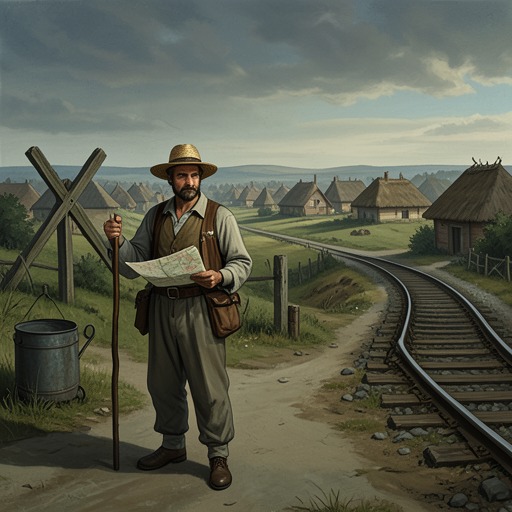
America is presented as the destination of the man who fled, and Antek is identified as that man. The dialogue makes clear that he left before the authorities could establish his guilt; it does not specify when or how he travelled, or what happened after his departure. His flight therefore stands in the account as an avoidance of the proceedings and punishment he fears, not as evidence that the charge was resolved.
The possible sentence gives that fear a specific scale. Antek reacts with dismay to the prospect of ten years, and the conversation adds that much of the term could be spent at hard labor. The comparison with a man from Wolica, who returned from prison at Easter after serving time, makes imprisonment sound prolonged but survivable to the speaker; Antek, by contrast, recoils at the duration. The passage does not confirm that he received this sentence. It shows the sentence as a feared possibility that helps explain why flight seems attractive to those discussing his case.
Antek seeks the priest
In another scene, Antek meets The Parish Priest of Lipce after having already gone to the presbytery. The priest explains that he has come out to pray and mind the horses because Walek has hurried off to the manor. He complains that the horses are difficult to manage, then points out the contrast between Kłąb’s flourishing clover and his own frost-damaged seed, where only chamomile and thistles remain. The exchange situates their meeting amid ordinary parish duties and agricultural concerns rather than in a courtroom or official inquiry.
Antek sits beside the priest and slowly begins explaining why he has come. The priest listens carefully, pausing to shout at the horses and take snuff; Antek, meanwhile, falters, stammers, and grows confused. These details establish an attempt to speak, not its outcome. The passage does not explicitly say what Antek asks for or what counsel the priest gives him, so the meeting cannot be treated as a documented confession or a resolved plan. Set beside the talk of the accusation and the possible sentence, however, it marks a turn toward seeking a hearing while the danger surrounding the case remains unsettled.
Personal conflict alongside public jeopardy
A separate exchange between Antek and Jagna exposes the strain in their relationship. Jagna blames him for drawing her into a relationship and then leaving her alone; Antek answers bitterly that he did not ask her to become his stepmother and accuses her of having been with other men. Her reply is that he could have forbidden her or protected her, and her distress finally silences his defense and stirs his affection again.
This quarrel supplies no motive for the killing and does not establish that the woodsman’s death caused their conflict. Its relevance is the contrast between kinds of exposure in Antek’s story: the reported charge places his freedom at risk, while his exchange with Jagna reveals a private bond marked by blame, abandonment, and renewed tenderness. The account leaves both tensions unresolved. It gives no narrated scene of the killing, no confirmed conviction, and no stated outcome for the priest’s conversation, preserving the uncertainty that surrounds Antek’s choices and their consequences.